



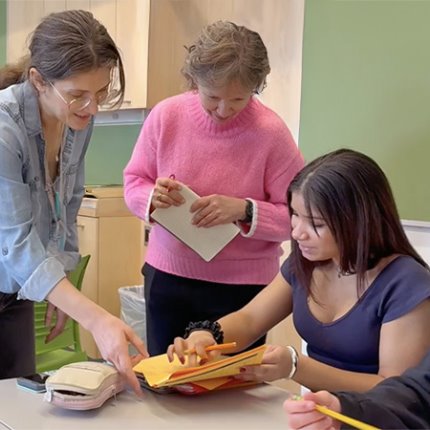



For Grade 3 students, the fall brings an especially memorable classroom visitor: the monarch butterfly. Building on an approach introduced last year, students take on the role of citizen scientists working on behalf of the New York City Parks Department as they explore this longstanding Friends study.
Their commission: investigate where monarchs come from and where they go—and consider why milkweed, an essential part of the monarch habitat, can be difficult to find.
Rather than beginning with the answers, students are asked to uncover them. As they observe caterpillars and butterflies through different stages of the life cycle, they record scientific observations and drawings, study maps, examine migration patterns, learn how scientists tag animals and investigate the role of milkweed in monarch survival. The study eventually asks students to communicate what they have learned through informative writing and other culminating work.
The approach grew from grant-supported curriculum work by Grade 3 teachers Jessica Contreras and Olivia Elliott, who spent summer 2025 reimagining the longstanding study. Their goal was to move students from receiving information to actively questioning, problem-solving and making discoveries for themselves. As Jessica reflected, the inquiry-based approach builds on children’s natural curiosity while creating opportunities for critical thinking, hands-on exploration and collaboration.
Those experiences connect directly to the School’s Portrait of a Learner, a framework that names the qualities Friends seeks to develop in students as they move through their education. In the Monarch Study, students practice Critical Thinking as they analyze letters, maps and articles and use evidence to draw conclusions about migration patterns. Empathy asks them to consider the people and perspectives connected to that story. Students learn about the decades of monarch research conducted by scientists and environmentalists in Mexico—including work that has not always received the same recognition as that of U.S. researchers—and explore the monarch’s significance within Mexican culture. In doing so, they encounter the migration not simply as a scientific phenomenon, but as a story shaped by people, place and culture.
Last year’s Grade 3 students worked with science teacher Steven Fong to plant milkweed in the School’s greenhouse, giving them a direct connection to the plant monarchs depend on for survival. This year’s third graders will continue that work by planting milkweed again, carrying forward a hands-on study of habitat, responsibility and stewardship from one class to the next.
At its heart, the Monarch Study asks students to consider a larger set of questions that will continue throughout Grade 3 social studies: How do living beings depend on one another and the land? What is lost or sustained as environments change? And what happens when a living thing’s connection to a place is threatened?
#FriendsSeminary #FSLowerSchool #FSGrade3 #FSInsideTheClassroom #FSScience #FSCuriosity #FSCriticalThinking #FSStewardship #FSPortraitOfALearner #FSProfessionalDevelopment


