In the Upper School, CPEJ supports students in taking increasing agency as changemakers within the school community and beyond. Grounded in the belief in the Inner Light in each person, students engage thoughtfully in community engagement and service, diversity, equity, and belonging initiatives, and global education. These experiences prepare students to reflect critically, act with integrity, and work toward a more peaceful, equitable, and just world. Friends Foundations Friends Foundations is a ninth-grade course that introduces students to the core principles of Quakerism and explores how these values shape community life, social justice, and global engagement. Students examine the history and practices of the Religious Society of Friends and consider how Quaker teachings inform contemporary movements for equity and inclusion. Through readings, discussion, service, and reflection, students develop a deeper understanding of how Quaker values guide their roles as members of local and global communities.
The Computer Science, Engineering and Design curriculum is structured to give all students a foundation in computer programming concepts and to allow students to expand upon their learning through a variety of electives. In a required ninth grade class, students begin by exploring concepts in data types, conditional statements, loops, and arrays before turning their attention to object-oriented programming. In semester-long electives, students practice the iterative design process to develop, test, and revise their work in a variety of programming environments and physical engineering projects. Students who meet prerequisites can continue their study at the Advanced level. In each class, students are encouraged to practice creativity and critical thinking as they design their own challenges to solve. Upper School students each have a laptop for use in class and at home. In using digital tools, members of the community strive to be mindful of the Quaker values of simplicity and stewardship: technology is meant to support our teaching and learning, not complicate it; and we care not only for the devices that we use, but the way our use of them impacts those around us.
The English Department aspires to teach students to read and write with accuracy, clarity, and elegance; to think logically, analytically, and imaginatively; and to engage in respectful and productive conversations. Meeting for Worship provides a model for our classrooms by encouraging us to listen, to use silence effectively, and to be open to inspiration. Students are taught in heterogeneously grouped classes. In small and large discussion groups, they work cooperatively on tasks ranging from deciphering a puzzling phrase to analyzing a metaphor to discussing the morality of characters and the moral stances of narrators and authors. Our students learn that a great work of literature is worth the time it takes to read—and reread—and that fine writing is worth the significant effort it takes to produce. We hope that students will experience both the pleasures of reading great literature independently and the pleasures of working to understand that literature together. The study of literature plays a distinctive role in teaching students about the diversity of human relations and cultures and in educating them to become citizens of increasingly heterogeneous communities; thus, the English program is an important part of what educates Friends students to “engage in the world that is” and to imagine “a world that ought to be.” Students encounter characters with whom they can identify and narratives that affirm their experiences as well as those that expand their understanding of worlds unfamiliar to them. As students contemplate the story of a character or community initially strange to them, they better understand differences and uncover surprising commonalities. If they carry these lessons from literature to life, then studying literature furthers Friends Seminary’s mission. The sequence of English courses 5-12, appropriately demanding at each level, provides students with a firm grounding in many facets of the study of English—grammar, vocabulary, reading comprehension, literary history and analysis, prosody, and writing in various genres. Developed over decades and reviewed regularly, the curriculum for each grade level includes common texts and skills that ensure that students in different sections receive the same basic training. We collectively consider what changes will best invigorate our classrooms and serve our students. Our methods and materials, including study guides and model essays, show our students what constitutes accurate reading, lively interpretation, sound argument, and clear writing. We welcome a diversity of interpretations even as we counter the perception that every interpretation of a text can be valid. We trust that all of our students can learn the skills of keen observation, logical interpretation, and argument development and that these skills will make them better readers and better citizens.
The Health and Wellness Department at Friends Seminary is dedicated to nurturing the physical, emotional, social, and spiritual well-being of every student. Guided by the Quaker testimonies, we empower learners to cultivate lifelong habits of balance, resilience, and care for self and others. Simplicity: We encourage students to make thoughtful choices that support healthy living, focusing on balance, mindfulness, and the essentials of well-being. Peace: We foster environments where conflict is resolved through empathy, dialogue, and restorative practices, promoting harmony within self and community. Integrity: We model and teach honesty, accountability, and ethical responsibility in personal health and wellness decision-making. Community: We cultivate belonging by supporting collaborative learning, teamwork, and shared responsibility for collective health. Equality: We affirm the dignity of every student by providing inclusive, accessible, and equitable health education that respects diverse identities and needs. Stewardship: We inspire students to care for their bodies, minds, and spirits, as well as for the environment and resources that sustain our shared well-being. Through this holistic approach, the Health and Wellness Department strives to empower students to thrive as compassionate, healthy, and socially responsible members of their school, local, and global communities. One semester of Health & Wellness is required for each student in Grades 9 and 10.
The History and Social Science curriculum is designed to help students become both effective and knowledgeable citizens of their communities – local, national, and international – and to use the discipline of historical thinking to interpret the world in which they live. The curriculum helps students to place current problems and situations in a larger context that provides fuller understanding and, thus, the basis for informed action. In addition, the curriculum reflects a commitment to Quaker values such as the worth of every individual and the quest for social justice. Through the curricular offerings, students are encouraged to value diversity and inclusivity. All History courses emphasize class discussions, analytical skills, essay writing, and close examination of a variety of source material. The three years of required coursework includes a Grade 9 course focused on Beliefs and Belief Systems to introduce students to critical historical thinking and writing methods; Grade 10 World History from c. 1400 to the present that introduces students to both a global and regional approach in terms of understanding the development of the modern world; and in Grade 11, a foundational view of United States History that prepares students for more in-depth study in future courses.
Mathematics allows us to organize, analyze and visualize abstract concepts and make sense of relationships in the world around us. In all of our courses we strive to teach our students not only to calculate but also to appreciate the inherent beauty, power, and elegance of mathematical patterns and processes. Mathematical truth can be seen as reflecting the Quaker values of simplicity and integrity. The discipline of mathematics fosters academic focus, concentration, and perseverance in problem solving that can be applied to all that a student studies. Mathematics is a tool that helps students be informed citizens who know and understand the world. While in the Upper School, each student is required to take the equivalent of three years of math courses, including a geometry and an algebra II course. Great care is taken each year to place students in the appropriate course taking into account each student’s performance, readiness and individual goals. We offer a traditional progression of courses that lead to several levels of calculus and statistics and offer a range of diverse offerings as epidemiology, personal finance and geographical information systems.
Rooted in Quaker values of integrity, community, simplicity, peace, and the inner light in every individual, our Performing Arts Program fosters both artistic excellence and personal growth. In both our Music and Drama programs, students engage in rigorous, process-driven study, developing the discipline, creativity, and collaborative spirit essential to meaningful performance. We strive to cultivate reflective artists who listen deeply, support one another, and use their craft to inspire empathy and positive change within our school and the wider world. Students enrolled in Choral ensembles, Orchestra, and Jazz have two annual after-school concerts in the Fall and Spring. Additionally, we produce one Upper School Fall play and one Upper School Spring musical every year. Students do not need to be enrolled in Drama classes to participate in the play or musical. Students have the opportunity to attend professional performances like concerts, operas, and theatre productions. MUSIC PROGRAM The Music Program embraces the Quaker belief that every voice has value and that shared creation can reveal deeper truths. Through a challenging curriculum that blends technical mastery with thoughtful inquiry, students explore diverse musical traditions while cultivating disciplined practice habits and refined ensemble skills. Our mission is to nurture musicians who listen with intention, contribute generously to the collective sound, and recognize music as a powerful vehicle for connection, reflection, and peace. Whether in choir, instrumental ensembles, or advanced coursework, students are encouraged to pursue excellence with humility, curiosity, and respect for the unique light within themselves and others. DRAMA PROGRAM The Drama Program strives to encourage growth in students’ understanding about human behavior, themselves, and the world in which they live. Drama offers a synthesis of language, feeling, and thought, which can enrich the individual’s inner world and increase his or her awareness and understanding of the outer world. It also fosters competence and confidence. Often working thematically, students develop skills in mime, improvisation, characterization, fluency of expression, working with text and working harmoniously with others. Through class work and productions these skills and attitudes are coupled with the development of performance skills.
The Upper School Physical Education & Dance program at Friends Seminary is designed to support students in developing lifelong habits of movement, wellness, and self-awareness while honoring choice, balance, and individual pathways. Grounded in the school’s mission and Quaker values, the program emphasizes reflection, personal growth, and thoughtful engagement in the broader community. Students fulfill their PE & Dance requirement through a combination of in-school courses, before- and after-school offerings, and participation on Friends athletic teams. Course options are intentionally varied, allowing students to engage with physical activity in ways that align with their interests, strengths, and schedules. Offerings may include fitness-based classes, yoga, rock climbing, martial arts, and a range of dance experiences that emphasize creativity, expression, and collaboration. Across all classes, students are encouraged to challenge themselves appropriately, build confidence, and engage fully in the learning process. Athletics play an important role in the Upper School program. Students who participate on Friends athletic teams earn PE credit through their seasons, reinforcing the connection between teamwork, commitment, and physical well-being. For students pursuing intensive training outside of school, a formal exemption process ensures accountability while honoring meaningful athletic and artistic commitments. Together, the Upper School PE & Dance program aims to help students graduate with a positive relationship to movement, an understanding of personal wellness, and the skills to make healthy, balanced choices beyond Friends Seminary.
Upper School Science at Friends Seminary invites students to become curious, confident thinkers who engage deeply with the world around them. Rooted in the Quaker belief in continuing revelation, the program views science as an evolving process of discovery, one that values thoughtful questioning, reflection, and integrity. Students learn that understanding grows through experience and evidence, and that the pursuit of knowledge is both meaningful and collaborative. In every Upper School science course, students actively participate in the scientific process. Through hands-on labs, data analysis, and collaborative problem-solving, they learn to construct models, test ideas, and support claims with evidence. This dynamic approach mirrors the work of scientists in the real world and helps students develop strong analytical skills, clear communication, and intellectual independence. As scientific knowledge continues to expand, the Upper School science curriculum focuses on essential concepts and foundational skills that prepare students for advanced coursework and college-level study. Guided by the Quaker value of simplicity, students build deep understanding rather than surface coverage. Graduates leave Friends Seminary well prepared for rigorous science programs, confident in their ability to think critically, adapt to new challenges, and engage thoughtfully with science in their academic and professional lives. For students seeking the highest level of scientific challenge, Friends Seminary offers an Independent Science Research Program. Through sustained, multi-year research projects conducted under the mentorship of faculty and professional scientists, students engage in the practices of working researchers: reviewing scientific literature, designing investigations, analyzing data, and communicating findings. The program provides exceptional opportunities for advanced study and intellectual independence, preparing students for competitive college science programs and future work in research, medicine, engineering, and related fields. Learn more about the Independent Science Research Program.
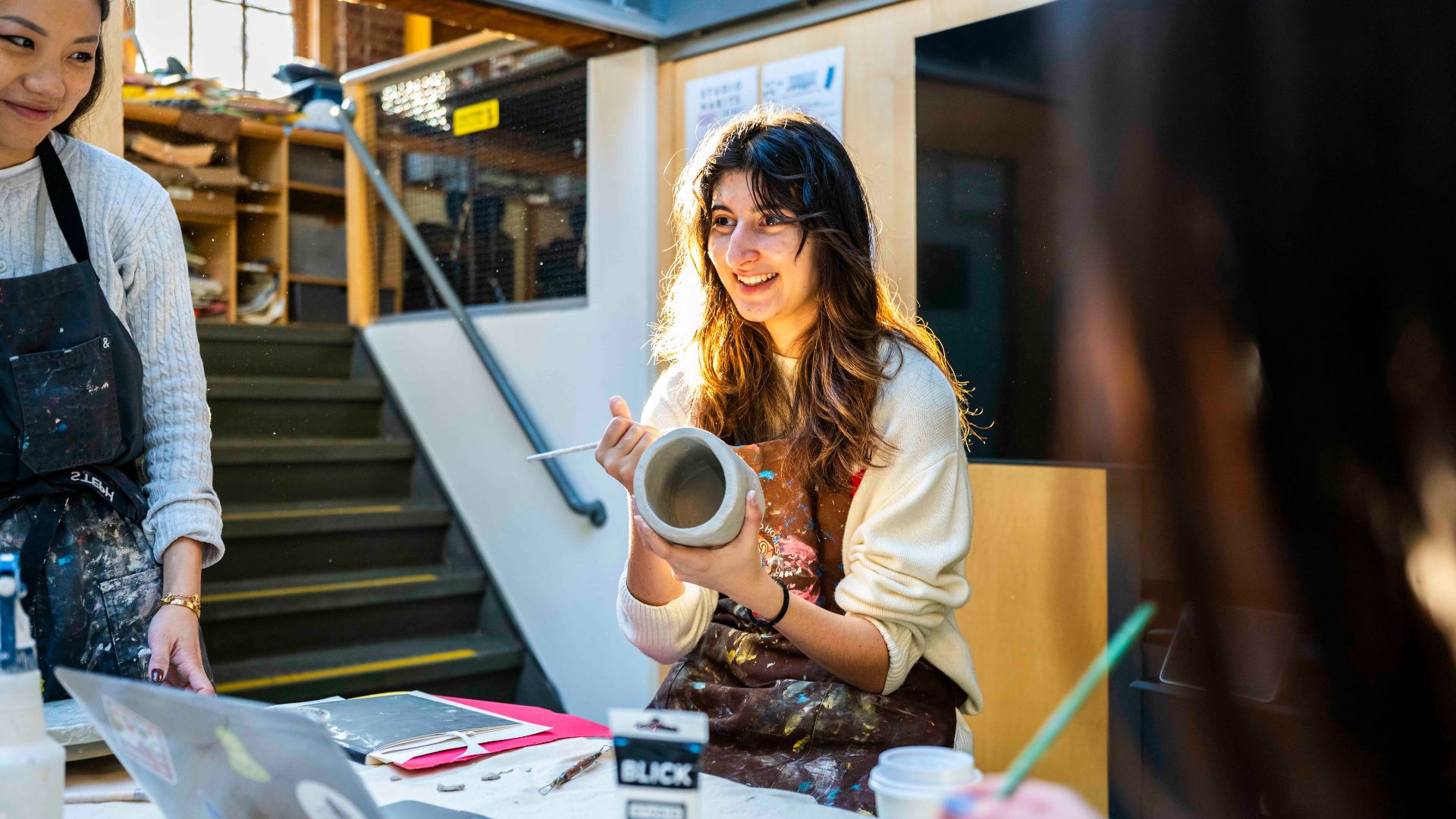
The Visual Arts Program at Friends Seminary provides a place for all students to explore and share their creative potential within an environment grounded in Quaker values and inspired by the urban vitality of New York City. Throughout the program, from Kindergarten through Grade 12, the Visual Arts curriculum celebrates each student’s inner creativity by encouraging close observation of the visual world and by supporting them in expressing their unique vision with increasing skill, reflection, and discipline. Rooted in the foundation of Friends education, the program nurtures learning that transforms—fostering imagination, empathy, and mindful making. Within the calm of Quaker urban tranquility, students discover how creativity can both center the individual and connect communities. Friends Seminary is committed to offering a rich program in both traditional studio arts and twenty-first-century new media. Students are encouraged to explore a diversity of materials and methods as they develop their own voices as artists, thinkers, and makers. Most courses can be taken at increasingly advanced levels. Students who wish to continue deepening their practice—for example, moving from Ceramics to Ceramics II—will be challenged with new techniques, processes, and creative inquiry. Course Offerings Include: 2D Art: Intro to 2D Design 2D/3D Art: Personal Narrative Sculpture: Materials and Process Painting Ceramics Digital Photography I & II Advanced Studio Architecture Art History: The Art of the Renaissance Art History: The Sacred in Art Digital Painting & Design Drawing Film and Animation Graphic Design Yearbook
The Department of World Languages views the study of language as a practice of connection, inquiry, and responsibility that grows alongside students as they move through the Upper School and toward greater independence. The department seeks to nurture students who are empathetic, collaborative, and intellectually curious, and who recognize the Inner Light in themselves and others. Through engagement with ancient and modern languages, students develop the ability to listen deeply, think critically, and communicate with clarity and purpose as they explore cultures, histories, and ideas across time and place. In the Upper School, language learning becomes an increasingly rigorous and reflective process that prepares students to engage with the wider world as thoughtful, resourceful, and globally-aware citizens. Students are encouraged to take intellectual risks, embrace complexity, and develop independence as readers, writers, and thinkers. Through translation, analysis, discussion, and writing, they learn to evaluate evidence, construct reasoned arguments, and engage meaningfully with diverse perspectives. In keeping with Friends values, students are invited to see both collaboration and challenge as opportunities for growth, recognizing that shared inquiry and thoughtful competition can deepen both individual achievement and community learning. The study of world languages cultivates habits of mind that extend far beyond the classroom. Students develop persistence, attention to detail, and the ability to reflect on their learning process as they work through increasingly sophisticated texts and ideas. They deepen their interaction with digital resources, learning to question and analyze the myriad of materials available. Faculty support students in making connections across disciplines and in applying their language skills to broader questions of culture, identity, and human experience. Through these experiences, students are encouraged to consider how language shapes understanding and how communication can foster empathy, justice, and global awareness. Rooted in Quaker values of integrity, equality, peace, simplicity, service, and community, the Upper School world language program emphasizes both personal growth and responsibility to others. Students participate in a learning community that values silence, reflection, and dialogue, where shared presence strengthens self-awareness and connection to others. Through academic study and experiential opportunities, students are encouraged to put their learning into action and to recognize themselves as part of a larger global community. The department aims to prepare students not only for academic success, but also for lives of thoughtful engagement, compassion, and meaningful contribution beyond Friends Seminary. Graduation Requirement: 3 consecutive years of the same World Language